Teach Less, Teach Better, Teach It Again and Again

“I taught a lesson to my students.  They should have learned it.” 

Some students learned “it”, and some did not.  And some tuned out and were not mentally present for learning.  Walk the hallways of any school.  Stop to look in and watch the teaching and learning act in motion.  We see the teaching.  We assume the learning.  At the end of any lesson, we may hear the teacher sigh with this assumption.  “There.  I taught it.   They should have learned it”.  Or was it exasperation.

What do we know?

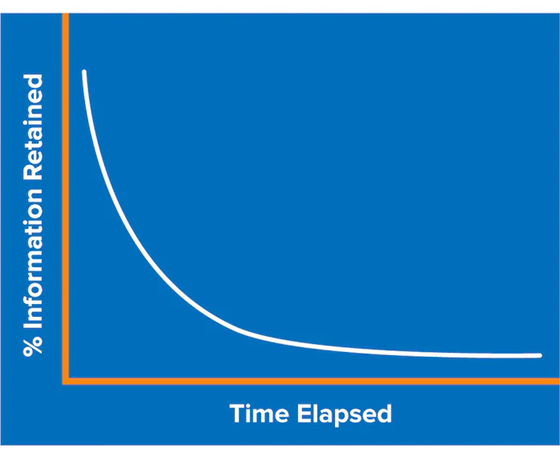
We don’t remember all that we are taught for very long.  This is a fact.  Hermann Ebbinghauss, a German psychologist, explored memory and why we forget.  His work in the 1880s has been replicated and validated over time.  His “forgetting curve” is instructive today.

“We forget 50% of the new information we are presented within 24 hours and 90% of that new information within a week.”

Perhaps the above statement should be emblazoned on the back wall of every classroom for teachers to constantly read as they teach.

https://www.mindtools.com/a9wjrjw/ebbinghauss-forgetting-curve

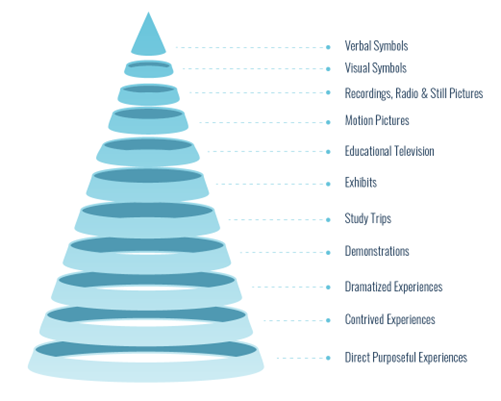
Ebbinghauss’ “forgetting curve” corresponds with Edgar Dale’s “Cone of Experience”.  In the 1960s Dale posited what he called the “Cone of Experience”.  Dale examined how people receive information.  He developed a model portraying the effectiveness of the mode for presenting new information and memory.  The isolated act of reading was the least effective while designing and making a presentation was the most effective. 

Later, misinterpreters of Dale’s work relabeled it the “Cone of Remembering” and this misinterpretation has been repeated until many believe it as factual.  This is the misinterpretation.

WE REMEMBER

10% of what we read.

20% of what we hear.

30% of what we see.

50% of what we see and hear.

70% of what we discuss with others.

80% of what we personally experience.

95% or what we teach others.

This is Dale’s Cone of Experience.

Presentation modes of verbal and visual symbols (words and graphics) are impersonal and less well remembered while the four experiential activities at the bottom of the cone require personal engagement and result in better retention.

https://uh.edu/~dsocs3/wisdom/wisdom/we_remember.pdf

Ebbinghauss and Dale inform us that memory is fickle and short-lived if it is isolated and left alone.

Capitalize on learning and make it memorable.

Further, Ebbinghauss’ research tells us that we can reduce the decline of memory by using several instructional strategies.  He found these to reduce forgetting.

  • Reinforce content, skills, and dispositions about learning regularly.  We know from retention theory that if we want information or skills to be accessible in short-term memory, students need 5-7 repetitions of mentally or physically working with they are to remember.  Theory tells us that 18 – 20 repetitions are required to create long-term retention.  If the biggest loss of memory is within one day, repetition must be at least daily to begin building memory.  This clearly is Ebbinghauss.

Consider automaticity of math facts.  We teach and drill children to learn addition, subtraction, multiplication and division math facts in the primary grades.  Then in the upper elementary and middle level grades we assume these facts are secured memory for all students.  In fact, they are not.  If we want to ensure automaticity, repeat episodes of the several times every year.  Make a game of it but do it.  Assumptions that children remember almost always leads to problems.

  • Presentation matters for clarity of what is to be remembered.  Make the new information easier to comprehend and absorb.  Assign smaller chunks of material to be read or watched.  Use visuals and graphics to assist students to make a clearer understanding of new information.  Build outlines, maps, and graphic organizers for students to link new information to what they already know.  This clearly is Dale.

https://www.lucidchart.com/blog/types-of-graphic-organizers-in-education

  • Make learning relevant and personal.  Motivation theory tells us that when students see themselves using new information or skills, they are more receptive to new learning and invested in remembering it.  Personalizing new learning gives students a purpose for learning and remembering it.
  • Make learning active not passive.  Use as many modalities for students to engage with new learning as are reasonable.  Approach new learning verbally – say it, write it, interpret it in a different language.  Approach it creatively – draw it, paint it, sculpt it, build it, sign it, and act it out.  Be careful not to let the projection of new learning become more important that the new learning itself.

https://asc.tamu.edu/study-learning-handouts/using-learning-modalities

What to do – Teach it, Teach it better, and Teach it again and again.

Teach less.  A grade level or subject area curriculum always contain more learning than can be accomplished within the confines of school year.  A teacher who says, “I taught everything in my curriculum or course guide” either has Cliffs Notes as a guide or is settling for very minimal student achievement in the end of year assessments.  This is not a license to discard a curriculum or course guide, but to carefully select the essential content information, skills, and dispositions that all students must learn and remember.  Both words are critical – learn and remember. 

Teach it better.  Use sound theories of instruction to build student retention and use of what they learn.  Chunk new learning for clarity.  Provide organizers of connecting new to secured learning.  Use multiple examples to help challenged learners find a connection to new learning.  The use of sound theories to teach essential new learning by itself will propel student achievement.

Make it meaningful.  Attach new learning to what students already know.  Attach new learning to the interests of the students, their families, and their community.  Attach new learning to what students will be learning and doing in their educational and career futures.  Once a child finds a purpose for learning, get out her way and simply coach her along the way.

Teach it again and again.  We parse our curriculum into units and chapters and almost never reteach or return to a unit or chapter once we complete it.  Then we wonder why students at the end of the year cannot recall with completeness or clarity what they learned at the beginning.  Take the time to repeat a chapter review from several chapters ago.  Check to know what students remember and can to with completeness and clarity.  If that knowledge or skill is essential, teach it again.  Do this rear-view mirror chapter review throughout the year.  You will see better student performances on end of year tests and future teachers of your students will be amazed at their longer-term memory.

Are You Volunteering for an AI Dope Slap? 

I know we don’t use physical violence in education, but if there ever was a time for a good old-fashioned dope slap it is now.  2001 Space Odyssey’s Hal in the form of generative AI is across the street from our campus and, if you are not prepared for Hal not only telling when the school day starts or perhaps analyzing student achievement scores or handing you a virtual pink slip, then prepare for a virtual dope slap.  AI is not coming; it is here.  Oh, “Hi, Hal.  Let’s talk about some creative lesson planning.” 

Two C words: certainty and change

Shakespeare’s Antonio (The Tempest) taught us “the past is prologue to the future”.  We can learn from Antonio.  Educators act the part of traditionalists in most scenarios.  We prefer the certainty of yesterday and today and aver change in the unknowns of our future.  This is a stereotype perhaps, but accurate.  If we consider the past half century, it safe to say that most teachers do not deal well with uncertainty or loss of control.  They like and lock in on a six-period day, a nine-week quarter, and a four-quarter school year.  Children are to be at their desks and ready for instruction when the class bell rings.  Keep your cell phones in your pocket or I will confiscate it!  Suggesting changes to the school day and school year or class structure disturbs the institutional status quo and school is an institution.  We like lateral change, if there is to be change at all.

Like adults in other occupations, when educators feel change is being done to them rather than by them, they become even more change resistant.  A diagram of change theory shows that there always is some initial resistance, a bump in the graph line, to the installation of change.  Teacher attitude toward change is that bump.  Also, there is a pecking order in a school and teachers have status in that order; change risks their loss of standing.  Change also raises issues of insecurity.  Change too often is viewed as a determination that things were not going well or even were going badly.  If not, then why change?  Lastly, change often necessitates new learning and veteran teachers frequently resist going back to school.  In our institution of public education, change happens but it has not always been a happy time. 

https://www.edweek.org/education/opinion-10-reasons-your-educators-are-resisting-your-change-initiative/2011/05

Moore’s Law and AI

Gordon Moore posited in 1965 that “the number of transistors in an integrated circuit doubles about every decade.”  In 1975, he modified the observation to “doubling every two years”.

https://en.m.wikipedia.org/wiki/Moore%27s_law

We use Moore’s Law simply as a statement that the rate and degree of change in technologies is ever increasing.  When applied to generative artificial intelligence, the rate and degree of change can be measured monthly not in two years’ time.  What AI could do last summer is now history to what it can do this winter.  And, if the past is prologue to the future, generative AI’s reach into our culture is growing exponentially.  Consider reading these sources among so many others on the Internet.

https://hbr.org/2022/11/how-generative-ai-is-changing-creative-work

I am an educator.  I am not a technologist.  I rely upon my capacity to read and listen and study.  I encourage all educators to do the same.  As my thoughts about generative AI are constantly changing, I dabble in the uses of AI for educational purposes.

In my role as an educational consultant for teacher preparation programs, I write courses to teach teacher candidates how to teach.  I am using Chat GPT 3.5 to start the writing process.  Chat never is the finished product, but it is remarkable how, with carefully worded prompts appropriately loaded with the names of instructional leaders and the titles and key concepts of their works, Chat prints a respectable outline in seconds of time.  A better prompter no doubt would cause a better outline.  However, the act of using Chat GPT moves me to wonder not only how can classroom teachers can use generative AI but how can they teach children to use generative AI to propel their learning of our grade level and subject content curricula?

21st century skills and AI in the post-pandemic

Although the 21st century began 23 years ago, most of our public-school curriculum is written for 20th century goals.  The Common Core standards were a 2010 recapitulation of curricular objectives at the time.  Reformers of education and student learning strove to create new strategies to bring all children to common benchmarks of performance of 20th century curricula.

As devastating as the pandemic was to national health (1,000,000-plus deaths), the economy, state and national politics, and our understanding of truth and lies, it does pose one very positive educational opportunity.  We can use the pandemic as a 20th to 21st century skills divide.  In the post-pandemic, we can make 21st century skills the focal outcome of a 21st century education not the vehicle for carrying 20th century skills into a next century.

The Partnership for 21st Century Skills prepared by the OECD/CERI (Organization for Economic Development and Cooperation/Center for Educational Research and Innovation) listed the following as learning and innovation; information, media, and technology skills; and life and career skills for children around the world.  These are the skills, they said, that will make the learning of core subjects (all that we teach in school) and core themes meaningful in the 21st century.

21st Century Skills:

  • Critical thinking
  • Creativity
  • Collaboration
  • Communications
  • Information literacy
  • Media literacy
  • Technology literacy
  • Flexibility
  • Leadership
  • Initiative
  • Productivity
  • Social skills

https://www.oecd.org/site/educeri21st/40756908.pdf

AI as a rough draft

Generative AI is the right tool at the right time to make each of these twelve skills come alive for children.  More than Googling the Internet, AI allows a student to craft a creative and intelligent product through the use of well-phrased prompts.  The product of AI is not the final product of student learning, but just the beginning.  Standing upon the shoulders of AI, students then make the product their own – they refine the AI rough draft.  And that is the power of the AI tool.

Whether it is an essay, an architectural rendering, a drawing of a bowl of fruit, the solution to a mathematical problem, a summation of the history of Rome, or the creation of a next Rubik’s Cube, the work process is the same.  Student prompts create an AI output that is the rough draft for student refinement.  We want children to learn how to prompt and then learn how to refine.  It is the refined product of generative technology and student talent that is submitted to a teacher at the end of the day.

Easy?  No way.  There is a boatload of instruction children need in order to be prepared to use AI.  There is a world of context that must be constructed in order for generative AI to be used appropriately and for its rough product to be understood.

Simple?  Not.  Veteran teachers today will remember the learning curve for teachers and students when hand-held calculators were introduced in schools.  Veterans will remember the learning curve required before desktop computer stations were placed in classrooms – one station per classroom was a big deal.  There was a learning curve required for laptops, notebooks, and IPad usage in classrooms.  Cell phones?  We still struggle with how that technology fits into teaching and learning.  AI is just another in the long line of innovations that require teacher and student learning. 

Don’t get in the line for dope slapping

NPR’s Car Guys taught me the term “dope slap” decades ago as a way to signal to another person that their stupidity is reaching the top of the stupidity gauge.  In the years since, I developed a virtual dope slap that is part facial part verbal and a whole lot visual.  No one gets slapped, but someone gets a clear wake up call. 

In the past fifty years of working in public education, I observed teachers who bragged about being Luddites.  I observed teachers move to the back of the room because they did not embrace change.  They are the Doubting Toms who believe the change will fail or go away.  I observed teachers as pioneers who did not run from change but stood in place and diligently worked with it until, over time, they developed new skills.  There are pioneers in every new innovation.  And I observed pathfinders who eagerly embrace change and are out in front of the rest of us in trying to understand and use features of the change.  Given every new technology innovation in education, there have been Luddites, Toms, Pioneers, and Pathfinders.

In a 21st century school, there is little room for Luddites.  They made their name and reputation in Britain’s textile industry two centuries ago; they failed then as they fail now.  AI is not coming; it is here.  Don’t get in the line for dope slapping and don’t be a Tom.  21st century children need 21st century teachers; be a pioneer or a pathfinder.  Be a teacher.  

Because Transparency Has Become Opaque Require Integrity

Each generation has its own edu-speak, those coined words used by educational professionals that are spoken so often and in varying contexts that they soon have no meaning.  These are not the acronyms that abound in school conversations.  We have long abused parents and the public with IEPs, RtI, and BIPs; educators love their acronyms.  I point to the whole words, single stand-alone words, that are used to convey a universal understanding of a concept or value that once stated assumes an end to the conversation.  The word transparency has become one of these and it is meh!  We say “Our decision-making processes will be transparent to the public” as if “transparency” is the end all.  The word is uninformative, uninspiring, unexceptional, and too often is a slight of hand or mouth.  “If I say we are transparent, we are transparent.”  Meh and more meh!

I read of a school board who touts transparency yet when the administration removed two dozen book titles from the school libraries, no board member could provide a rationale other than “we support the administration”.  End of conversation.  They lived their version of transparency.

Another school board claims transparency yet when the administration announces a multi-million-dollar post-pandemic shortfall coming in the next several years’ school budgets, there are no explanations of the decisions that led to gross expenditures over revenue in the recent past.  The task force delegated to create a solution to the huge shortfall is hand-picked and, by design, there will be little voice for the community who sit in school board meeting audiences governed by a very restrictive public participation policy.  Transparency up to a point but no further.  One has to appreciate the complicity of a person who says, “It is transparent to me”. 

I know a school administration that grieves over the drop of student achievement scores in the post-pandemic yet will not make achievement data available to the parents beyond the statewide school report card.  School leaders declare they are being transparent about the continued school ratings of “This School Does Not Meet Expectations” yet there is no accountability for low achievement year after year in the same grade level and classrooms.  It is a personnel supervision problem more than a student achievement problem.  This is an example of being transparent about what does not matter and not transparent about what does.

Stop using the word transparency.  Another way to explain the need for changing this word is that people today say transparent, but they mean translucent.  The clarity of truth and facts has given way to lies and non-facts that are spoken so openly and freely that no listener can take the words of a person in authority at face value.  We have come to expect if not accept cloudy translucency.  This is wrong.

Start using the word integrity, as in “We make all decisions with the integrity our students, parents, and community deserve”.  Integrity, meaning the quality of being honest and having strong moral principles, is not meh.  Integrity describes the direct, honest, data-based, straight-forward answer that a person who asks an honest question deserves.  While there may be a shading in information that claims transparency, a response to a question or problem either is made with integrity, or it is not.

https://www.merriam-webster.com/dictionary/integrity

I know a superintendent who told his faculty and staff first and then his parents and community, “… regarding the teaching of reading, we have been doing it wrong.  For the past 30 years we have taught children about reading but not how to read.  We did not use a phonics-based, literacy creating instructional program.  Instead, we asked each child to look at the pictures or listen to an adult read and asked children to memorize words hoping that these three strategies would cause a child to become a reader.  And we did this year after year.  Today, we stop that nonsense and are beginning to teach each child how to read.  I invite you to come to school and watch us make these changes”. 

Transparent, yes.  But more to the point, his declaration has integrity.  Communicating and acting with integrity is easier and less stressful than the work needed to obfuscate and maintain an obfuscation. 

We find examples in our daily communications about children and school that are simple and factual and relatable.  As listeners and observers, we must thank and applaud clear and uncompromised communication and actions.  And we must be more stalwart in calling out “Nonsense” and “Bull Roar” when we are treated to an episode of translucency.  At the end of the day, it is better to deal with bad news than with a lie.

Learning Loss – Yesterday is gone, let it go!

Enough of the complaining about learning loss!  Our children will be okay.  Our second-hand adult worry about what children did not learn in the covid school years ignores the realities of the first-hand teaching and learning that successfully brought children back into school life that is preparing them for their future.

I watch the traditions of September unfold in our local school.  The school website shared faces and names of new teachers; each brimmed with excitement for their new school home.  Elementary grade newsletters shared information about the start of the school calendar so parents could plan ahead and be prepared.  Banners in the school yard welcomed children to the “23-24 year of learning”.  Our school celebrates the beginning of a new school year with all the excitement it deserves.

Athletic seasons give secondary students a quick blast of school in late August.  Football, boys’ soccer, girls’ volleyball, and both cross country teams practice and have their first competitions before the first day of classes.  There is a special strut to teams on the first day of school who already have wins in games, matches, and races.  Cockiness, maybe.  Pride, assuredly.

It is against this reality of September and a new school year that discussion of past learning loss needs to be put in a proper context.  To paraphrase Forrest Gump, “School is as school does”.  Our local school is active and forward-leaning.  It is known1 widely as offering a private education of small class sizes and maximum opportunities in a public-school setting.  Few, if any children in our school, look backward worrying about what did or did not happen in recent years.  They, their teachers, and their school start new learning in September based upon each child’s “readiness to learn” assessments and focused new instruction.  Forward leaning for forward learning.

In hindsight, life and learning took hits from the disruptions of pandemic mitigations.  Every child now in school will have lifelong memories and stories to tell about when schools were closed, and classes were zoomed.  They will talk of being quarantined and wearing masks, even in their sports.  They may tell stories of what they did while not in school or how they played hooky and “unplugged” from zoomed classes.  What they will not talk about is what they did not learn due to the pandemic because it will be have been inconsequential in the big picture. 

We are two school years-plus past those events: two school years of renewed schooling.  The swarm of academics, activities, arts, and athletics of school life embraced children on their first days back in their re-opened schools and few children ever looked back.  Adults, on the other hand, gather their worry beads and fume about lost learning.

Stop worrying and get in step with your children or grandchildren and their 23-24 school year.  For them, every day brings something new to learn and do and they are growing their learning not from what they missed or lost but from what they know and can do.  It is our proper role to assist them as we can and as they will let us.  Children are all about today and tomorrow; let’s join them and start moving forward.

Parent Demands in Public Education are not Parent Rights.

Hot button:  an emotional and usually controversial issue or concern that triggers immediate intense reaction.

https://www.merriam-webster.com/dictionary/hot%20button

Public education in the United States is a long story of hot button issues.  Emerging from a pandemic fraught with hot buttons – vaccines, school closures, remote education, quarantining, information and disinformation, lost trust in public schools – we may want a calmer educational environment.  But we are not getting calm.  The hot button today is parental rights in education – red hot!

What do we know?

Parental rights in education begin with two constructs.

  1. The US Constitution does not include any statement of parental rights in education.  The late Justice Scalia labeled parent rights in education as “unenumerated”.  As such, there is no basis for shaping law or policy based upon what the Founding Fathers wrote.  Specific rights to determine a child’s education are not extended to parents nor protected by the Constitution.
  • Nature abhors a vacuum.  In the absence of substance in a defined space, surrounding and denser matter will invade the space until the defined space looks and acts like its surrounding.  So, it is with parental rights in education.  In the absence of a legal basis, parental rights are whatever parent activism can carve out of the undefined space of law.

Why are these constructs important to understanding parental rights in education?  In any dispute regarding an act of the state, in this case a school district or school board, the argument is first reviewed under the Constitution.  Because education is not enumerated, attention is given to the 14th Amendment that ensures due process and establishes concepts of equal protection under the law. 

Although education is not a function of the federal government, Congress has taken action to ensure the rights of citizens within public education.  For example, the 14th Amendment provided for equal access to education and the end of racially segregated schools.  It also pointed Congress to pass PL 94-142 protecting the rights of, meeting the individual needs of, and improving the educational results for children with disabilities and their families.  PL 94-142 may be as close as the federal government has come to stipulating that parents and schools are equal partners in determining the best educational placement for their child.

Further, we know.

The US Constitution implies that each state government is responsible for the establishment of public education in its state.

In the WI Constitution, chapter 118.01(1) – Purpose establishes the authority for the creation of public schools.  “Public education is a fundamental responsibility of the state.  The constitution vests in the state superintendent the supervision of public instruction and directs the legislature to provide for the establishment of district schools.  The effective operation of the public schools is dependent upon a common understanding of what public s hooks should be and do.  Establishing such goals and expectations is a necessary and proper complement to the state’s financial contribution to education.  Each school board should provide curriculum, course requirements and instruction consistent with the goals and expectations established under sub. (2).  Parents and guardians of pupils enrolled in the school district share with the state and the school board the responsibility for pupils meeting the goals and expectations under sub. (2).”

https://docs.legis.wisconsin.gov/statutes/statutes/118

Eight goals for public schools in Wisconsin are enumerated in WI Stat 118.01(2).

https://docs.legis.wisconsin.gov/statutes/statutes/118/01/2

The duties and powers of a local school board are enumerated in the state constitution.  In 118.001 Duties and powers of school boards; construction of statutes, the legislature says “The statutory duties and powers of school boards shall be broadly construed to authorize any school board action that is within the comprehensive meaning of the terms of the duties and powers, if the action is not prohibited by the laws of the federal government or of this state. 

So, what do we know?

The US Constitution does not address education.  The responsibility for education is implied to the various states.

The WI constitution authorizes the state superintendent to supervise public education and local school boards to implement public education.  The constitution enumerates goals and expectations for public education in WI and authorizes school boards to create policies and rules to achieve these goals and expectations.  Parents and guardians “share” responsibility with the state and school board for assisting children to meet goals and objectives.

There is no constitutional or statutory discussion regarding the rights of parents.  Parents “share” in the responsibility to achieve the state’s goals in educating children.

What changed?

Educational policy is no longer about children but about adults.  Very few educational policies today are designed to improve or enhance teaching or student learning and achievement.  There are exceptions such as Act 20, Wisconsin’s new literacy and reading proficiency law.  Most policies today are written and enacted to achieve the political goals of adults.  The simple version of this story is that children in school don’t vote, their parents vote.  So educational politics focuses on satisfying adult voters.

Conservative populist politicians can build constituencies based on attacking social and cultural institutions, like schools, libraries, museums, and public media.  They exercise elected authority to shape public education in ways that appeal to voters and donors.  While they are not able to affect federal policy, they use gerrymandered state houses to affect state legislation, state departments of education, and policies at the local school district level.

Education is a soft target because everyone is a product of childhood education and from their experiences is a self-made expert about schools.  Public education is a soft target because it is large and statewide and a problem in one school district can be implied as a problem for all school districts – it is easy to generalize.  And public education is funded by tax dollars, and everyone favors reduced taxes.  Lastly, public education is attacked by those who want this most public of state institutions to give them as individuals what they want as individuals and to codify their specific wants into laws for everyone.

Governor Walker (WI) used Act 10 to diminish the connection between teacher unions and the Democratic Party in Wisconsin.  The Act had other ramifications for school operations, but its origin was to decrease the political power of public employee unions. Although the legislative slogan implied shifting power from collectively bargained contracts to school board decision-making, the realities of school financing changed very little over time.

Governor Youngkin (VA) campaigned on promises of empowering parents and restoring excellence in education.  With a Republican-led legislature, he banned critical race theory discussion in schools and retracted accommodations for transgender students.  His legislature also passed a pro-education budget to placate those opposed to his policy changes.  Youngkin empowers parents to be active in pushing conservative values at their local school board level with a “we support what you want” encouragement.

Governor DeSantis (FL) has gone beyond policy to enforcement with threats of incarceration and loss of teaching license for educators who do not comply with his mandates.  He states that “Florida is where woke goes to die” and “We will not allow reality, facts, and truth to be optional”.  Parental rights in Florida are only for parents who agree with their governor.  Rights are restricted for those.

Governor Reynolds (IA) moved the state legislature to significantly change school financing.  Now every child represents an amount of state aid regardless of enrollment in public, private, or parochial school.  Every student is a voucher, and every school is a voucher school.  It does not jive with the Founding Fathers’ separation of church and state, but it passes muster with Iowa’s Republicans, and they are the votes who matter to Reynolds’s.

The pandemic re-taught Americans that all politics are local.  School board meetings are open to public participation and typically have less than a dozen residents in attendance.  Parents with a pandemic-based purpose found that a school board confronted by a vocal handful could either command board members to approve their policy demands by their loud and in-your-face presence or cause boards to shut down and adjourn meetings without enacting the posted agenda.  Neither outcome was good for the school district but accomplished the goals of selected parents – give me what I want.

While most school boards did not experience a capitulation or shut down, board meeting confrontations were common enough to shift the traditional relationships between parents and board members.  Parents who disagreed with pandemic masking disenrolled their children seeking a school with more favorable policies.  Parents who disagreed with quarantining and school closures disenrolled in favor of home schooling.  And parents who disagreed with masking and closures and kept their children enrolled in the school became constant voices at school board meetings and in local media.  Goodwill and traditional trust were eroded on both sides by what was said and written by both sides.

The relational upshot from the pandemic is that growing numbers of parents want and demand an active voice in the daily operations of their local school.  Voice no longer is about masking, but is about the books in classrooms and libraries, the curriculum that is taught, and the language and dispositions that teachers use in daily teaching that are subjected to parental review.  It is about partitions between genders.  It is about diversity and inclusivity.  A new status arose from the pandemic – a parent has the right to determine school policy and rules regarding her child. 

The Big Duh!

There is no legal authority in our public law for parental rights in education.

There is a growing charismatic authority in political leadership that wants to give specific rights to parents relative to public education in exchange for the political support of those parents.

The dichotomy between the public and parents lies in the fact that public education is created to achieve the public’s goals in educating children not the goals of individual or groups of parents.

Rights and demands are two different things.   Politics has the capacity to give legitimacy to parent demands, turning them into legislated parent rights.  This is a changing landscape with an unknown future.  What the pendulum swing of one partisan legislature approves may be disapproved when the pendulum swings again.

At the end of the day, public schooling is about children not about parents.  Parents choose the school in which to enroll their children and share with teachers and school leaders in the responsible assurances that all children will achieve the school’s educational goals.  Excepting the provisions of specific laws, such as PL 94-142 and approved 504 plans, that is the extent of parental rights.