

Theory to Practice: Teach for Retention or Forget Teaching It. Your Students Will.

I said it. Students heard it. Students will remember it. Not really. Educators assume or expect students to remember, but assumptions are not facts. Remembering what a teacher said is a struggle between working memory and brain dumping. If there is not an overt effort to retain what is heard, seen, or perceived, the working brain will dump what was heard, seen, or perceived within 30 seconds. That is a fact. A teacher who wants children to remember what they have been taught must know and practice principles of retention theory. If not, teaching is a wind that blows through children’s minds leaving little that was learned.

What do we know?

Retention is the unspoken assumption in everything we do in school. We want children to remember what we teach them. We test the heck out of students as an assurance that they remember their instruction. We reward children with high test scores and create tiers of intervention and remediation for children with low test scores. Test scores have become our measurement of retained memory. In fact, this pathway almost ensures that instructed learning will not be retained. It is based on false principles and practices.

Let us remember what we know about remembering.

  • The brain is bombarded with thousands of words, images, sounds, and perceptions every hour. The brain is not designed to and will not remember every input it receives.
  • If the brain does not consider/mentally repeat a word, image, sound, or perception it is lost within 30 seconds. The 30-Second Rule is reality.
  • The brain considers to seven to ten bits of information at a time – there is a constant pass through of information in immediate recall. The 30-second rule constantly moves the brain to “next” and “next.”
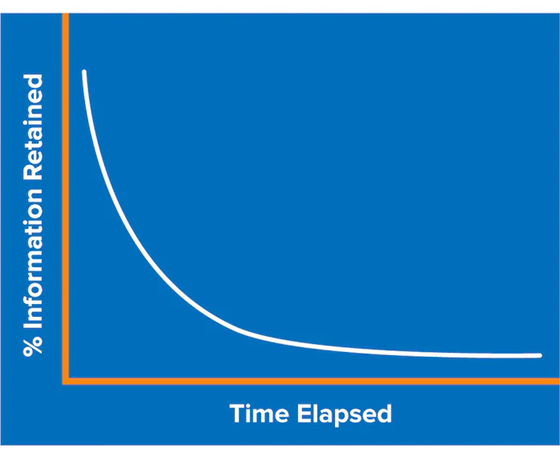
  • The Forgetting Curve also is a natural function of the brain’s need to be moving on to what is next in life. We forget 50% of received information within one hour and 70% within 24 hours without overt actions to reinforce the retention of that information.

Humans innately forget. If we want to students to remember, we must overtly use practices that cause them to remember. Retention theory must be embedded in every instructional lesson and unit.

Retention Theory

Madeline Hunter named five principles that cause students to remember instruction.

Meaning. One way to combat the 30-Second Rule is to make unfamiliar information meaningful. Brain retention improves when it knows that unfamiliar information connects to what a student already knows or the student’s personal interests. Personal interest is huge in reinforcing memory. She called these connections “anticipatory sets” or ways to overtly move the student toward a positive anticipation about a new lesson. This prepares the brain for memory.

Feeling Tone. Every classroom involves emotional theater, and teachers set the positive, negative, or neutral vibe in which teaching and learning happens. A teacher who has skills of affective and behavioral empathies creates a warm, inviting, and positive atmosphere. The lack empathetic skills and teacher-dominated class time builds hesitant, non-participative student responses in a negative climate. Positive and negative feeling tones are real – teachers know it when they are in one or the other, but do not always know their causations. A neutral feeling tone arises when there is a perceived indifference to whether children learn or not.

Degree and accuracy of Initial Learning. Both correct and incorrect learning lead to memory. Correct learning can be reinforced leading to long-term memory. However, incorrect learning needs to be identified, eliminated, and replaced with correct learning. Although interventions are required, they cloud reinforcement as the brain processes incorrect information out and correct information in. Therefore, when teachers take time to ensure all children achieve high levels of understanding of new instruction before moving to independent practice, teachers are enhancing memory work and retention.

Practice Schedule. Practice does not make perfection, it makes permanence. Theories show that massed practice or “cramming” is effective for fast learning that leads to quick forgetting. In contrast, distributed practice episodes are the key to long-term retention. Practice in retrieving remembered information builds memory muscle and intervals between practice sessions build permanence.

Transfer. The goal of teaching and learning is knowing things that are worth knowing and that can be applied in various new ways, places, and times. Retention of prior learning is reinforced when it is recalled and used in new contexts, and new learning is better understood and remembered when new memories are extensions of older, successful memories. Transfer that connects learning connects memories.

What to do. Each of the following describes a strategy for building and reinforcing retention based upon retention theory.

  • Make information “sticky” and easier to remember. Information is not created equally. Some seems slippery and is hard to remember while other information, like tree sap that clings to fingers, seems sticky and is easier to remember. These strategies make information sticky.

Chunk it. Individual bits of information are hard to remember, but easier when chunked in meaningful groups or sequences or patterns. Chunking means remembering all the individual bits as one – it is easier to remember.

Show it. Research shows that human memory of images is better than memory of independent text or audio. A picture, a video, or a graphic gives the brain another dimension of unfamiliar information. The student sees the word and an image of the word or picks up a representation of the word. Things that can be handled and made tangible, are very memorable.

Add emotional or novelty context. The easiest emotions to embed in new learning are surprise, happiness, and fear. Children love things that go “bang” or have surprise endings. They associate the surprise and the information. All learners appreciate novelty – new things to experience. Just saying “You are the first students to …” makes whatever it is they do “sticky” in their memory.

Do it. Motor skills and experiences are stored in different areas of the brain from information. Teaching about graphing coordinates in math class creates information. Creating a grid on a soccer field and placing/locating things by their coordinates creates a know it/do it combination that is very sticky.

Conversely, there are ways to make information slippery and hard to remember. Avoid or eliminate slippery practices, like giving students lists of random numbers or facts to remember without any context for their memory, allowing passive listening without note taking or required verbal engagement, or giving students information that is highly similar/almost identical to prior information.

  • Use active not passive retrieval of information. Memory requires mental activity and working the information until it avoids the brain dump, becomes short-term memory, then long-term memory, and is transferred to give meaning and context to other information. Passive retrieval relies on a student’s initial interaction with the information and rereading or repeating the same initial interaction. Passive retrieval yields low grade memory retention and leads to very quick forgetting.

What Did You Miss? After first instruction, ask students to write all they know about what they learned. Allow ten minutes. This on-demand retrieval exposes what the student remembers and, when compared with the totality of the first instruction, what is missing.

Discriminating Retrieval. Give students an explanation of the first instruction but one that is missing some information. Ask students to fill in the missing information. This retrieval requires to brain to “work” to clinically retrieve, consider, and identify the parts of the information.

Practice testing and retesting. The strategy of pre-testing and post-testing most often are used to inform and assess instruction. Pre-testing and subsequent testing also work to build and reinforce memory. In any test, students reinforce what they correctly remember. Testing strengthens successful memory retrieval.

Feedback loops. Testing also provides feedback about what students do not know. Focused work on improved reading, listening, seeing, and experiencing of unknown or non-secured information builds new memories. The active work needed to correct misinformation and learn correct information mentally strengthens memorization of what is learned.

Mental refinement/teach back (Feynman Technique). One of the most active is also the strongest retrieval strategy. When students teach what they learned to others, they must consolidate and refine the information they know, construct it in their own words, and deliver the information in ways the others can learn. We often hear that the best way to learn something is to teach it; that also applies to memorization.

  • Spacing. The term “spacing” tells us that productive, active retrieval must is purposefully distributed not massed.       

Intervals. Research suggests these intervals for moving new information into short-term memory and short-term memory into long-term. First review = 24 hours after first instruction. Remember: Without active retrieval, 70% of first instruction is forgotten in 24 hours. Second review = one week later. Third review = one month later. Fourth review = 3-6 months later.

10-30% Rule. Research recommends the optimal gap between retrieval/practice sessions should be 10-30% of the time you want students to remember the information. If the final test is in one month, use practice exercises every 3 to 6 days. If the final test or performance is in one year, practice once each month. For classroom rules that cover a school year, test/practice every month of the school year.

Interleaving. Do not practice the same information/skill at every practice session. Test/practice just a part of the same information at one session and other parts at subsequent sessions. And include different types of information in each session. This requires students to mentally sort through the memory, mine that information, and retrieve specific memories.

Leitner or Box Method. Everyday include a brief retrieval of new information and things students are having difficulty remembering. Every 3 days include a retrieval of things students are shaky on in their memory. Once every week practice information all students can retrieve easily.

  • Layered mastery. Best practice is not the constant use of one active retrieval strategy. Like physical exercise, using one strategy repeatedly only makes that one type of memory stronger. Layered mastery creates a multi-month schedule of intervals for brain dumping, testing, teaching to others that causes students to retrieve information repeatedly, analyze the information, apply the information, evaluate the reliability and validity of information, and synthesize the information into new configurations. When teachers use Bloom’s Taxonomy to guide their use retention theory, they cause students to build their own retrieval systems.

The Big Duh!

The industrial model of teaching and learning in the United States makes curriculum a conveyor belt of information that teachers teach, and students try to learn. The high demands and constancy of our K-12 curriculum delivery do not include time and resources for meaningful information retention. We teach and test then teach and test something new. If we want students to know what they learn for more than one day or until the next quiz, we must understand and use retention theory and its research-based practices. If we do not teach students to build memory building and retrieval, we truly institutionalize forgetting.
Knowledge, Like Water, Will Slip Between Our Fingers Unless.

When you cup your hands and use them to scoop up a drink of water, how long can you hold the water before it seeps between your fingers and out of your hands? Some can hold onto the water longer than others, but eventually the water slips from everyone’s hands. So, it is with our memory. We hear a name or phone number or read a story and for a bit of time we remember these. However, after a bit of time, that length of time varies with the person, recall of the name and phone number and the details of the story slip from our memory like water between our fingers. Short-term memory is only that, good for a bit of time. If we want to remember things for a longer stretch of time, we need to build long-term memory. We can build memories if we choose to do so.

What do we know?

We consider memory to be a natural phenomenon for keeping track of things. In everyday life, we have hundreds of micro experiences every day. These are things we see, and hear, and do as part of daily living. Yet we remember very few, because they were insignificant and occurred quickly and without reason to become longer memory. Our brains are not intended to remember everything we see, or hear, or do because there are thousands of these minutiae every day. Consider what it would be like inside your head if your brain were constantly trying to make sense of every detail in every second of your life. Happily, no one knows what your head would be like because this does not happen naturally. Instead, our brain sheds the minutiae in short order. Forgetting is as natural as remembering. Unless we actively work to build memory.

Being a student in school may build many memories but schooling itself does a poor job of teaching students how to remember. Our curricular program for every grade level and every course is industrial in nature. A teacher organizes units of instruction and teaches them one after the other. Sadly, schooling is assembly line instruction, and the conveyor belt only stops at graduation. The daisy chain organization of curriculum assumes that some of what a child learns at an earlier age will relate to or be applied in a later age. Certainly, a child’s developing skill sets in phonics-based reading and use of arithmetic skills are used throughout school and later life. However, what the child reads in fourth grade or the math work the child did in sixth grade are stand-alone assignments. 

Case in point – why do children in the United States typically study US history in grades 5, 8, and 10? The casual answer is that by teaching it again in 8th and 10th grade children develop a deeper understanding of their national story. If that were true, why do so many children have trouble on tests of US history? It is the most repeated curriculum in PK-12 yet ask any adult the name of the 8th US President or the relationship between the American Revolution and the War of 1812 or the effect of the Smoot-Hawley Act and you will wait a long time for answers. Are these important to remember? Maybe not, but they are indicative of how we treat this three-peat taught curriculum. Most American adults cannot pass the Immigration Service civics test. We are illiterate about our national story. So much for teaching children how to remember.

Being smart in school by remembering what you learn should not be a secret – help every child to be as smart as they can be. We need to teach children all the “secrets.”

Long ago and before the Internet’s instant access to information, knowledge was power. People who knew things and could do use their knowledge had advantages over people who did not know. Sadly, schools and teaching were a matter of “teachers know and children do not know – and only the smartest children learn what teachers know.” Too many of us experienced this in school.

Today our teachers’ job is to cause all children to learn what teachers know. A first-grade teacher’s job is to cause all first-grade children to learn the first-grade curriculum. A chemistry teacher’s job is to cause chemistry students to learn chemistry. This is teaching with an “I will do everything in my ethical abilities to teach my children what they need to know and do.”

Memory work is not easy, and it is not intuitive for all children. If a child has natural memorization ability, great! For children who need help memorizing, teach them how to remember. This mandate and constantly needs adaptive practice in every PK-12 classroom. We do not teach how to study and remember in elementary school and never again in middle and high school. We teach and practice these abilities in every classroom.

What to do better.

Start by acknowledging the current state of learning and remembering. We do not teach for long term memory. We do not teach children how to build long term memory, and our classroom practices do not build memory for the long-term. We talk about the importance of building, recalling, and using background knowledge but do not teach children how to recall and use what they have been taught.

Be intentional. Building recall does not take as much time and effort as reteaching what children have forgotten. “Children, we are going to learn how to improve our memory.”

  • Use recall events. Tell children “Before the next chapter or unit test, we are going to do things to help you remember what you are learning. These small activities will strengthen your memory of what you are learning before our usual tests.” Every several days have children “Tell me about the story we have been reading? I want to hear what you recall and your thoughts about the main characters, the plot, and where you think this story is going.” At the start, be non-evaluative and over time expect children to develop correct details. Have children tell each other about steps they have been taught to use in checking their multiplication problems. Do not just do the steps but explain why each step is mathematically important. Have children hum the song they are learning or restate the safety rules for using a turning wheel for pottery. Work on recalling the essential things in the current chapter or unit or story or class activity. Then, do it again next week.
  • Use non-graded retesting. Tell children “Frequent review of what you learned and was in a recent test helps you to remember what you learned. So, we will have several follow-up tests of that same information. The follow-up tests will not be graded, because we are taking these tests to build memory of what you already were tested on.”
  • Use flash cards. Have children make their own flash cards. This applies to all K-12 children in all subjects. Cards can be created to build recall for vocabulary and definitions, events with dates and names, series of steps in a process, and to explain significance. The practice of creating flash cards alone builds memory; the use of flash cards builds stronger memory.

No child is too old for flash cards! At age 77 I am relearning French language and flash cards are part of the routine.

  • Use intermittent review. Students tend to cram for tests. Tell children “Better practice is scheduled or intermittent review over time. Do not leave studying for a test until the last night before test day.” The recall events described above practice intermittent study. Use intermittent for end of course and end-of-year tests. Next month do a review of essential content and skills taught the previous month. Run through last month’s flash cards. Three months hence do it again. The reason is this – background knowledge, like water in your cupped hands, eventually will slip away if you do review/refill it.
  • Use memory organizers. Tell children “It is okay to create your own ways of remembering what you don’t want to forget.” Teach them how to draw a concept map linking ideas together as supporting details. Teach them associations to link new learning to what they know. Teach them how to create a rhyming word phrase so that each word reminds them of ideas and strings of ideas they want to remember. Teach them to use a simple sentence where each word reminds them of an idea or string of ideas they want to remember.

The Big Duh!

Return to a variation of Cartesian logic. “If I taught something to children and they did not learn it, did I really teach them anything?” Possibly. Instead posit, “If I taught children and did not teach them how to remember what I taught them, did I really teach anything?” Indeed, not. If you expect children to remember what you taught them, teach them how to remember.

Teach Less, Teach Better, Teach It Again and Again

“I taught a lesson to my students.  They should have learned it.” 

Some students learned “it”, and some did not.  And some tuned out and were not mentally present for learning.  Walk the hallways of any school.  Stop to look in and watch the teaching and learning act in motion.  We see the teaching.  We assume the learning.  At the end of any lesson, we may hear the teacher sigh with this assumption.  “There.  I taught it.   They should have learned it”.  Or was it exasperation.

What do we know?

We don’t remember all that we are taught for very long.  This is a fact.  Hermann Ebbinghauss, a German psychologist, explored memory and why we forget.  His work in the 1880s has been replicated and validated over time.  His “forgetting curve” is instructive today.

“We forget 50% of the new information we are presented within 24 hours and 90% of that new information within a week.”

Perhaps the above statement should be emblazoned on the back wall of every classroom for teachers to constantly read as they teach.

https://www.mindtools.com/a9wjrjw/ebbinghauss-forgetting-curve

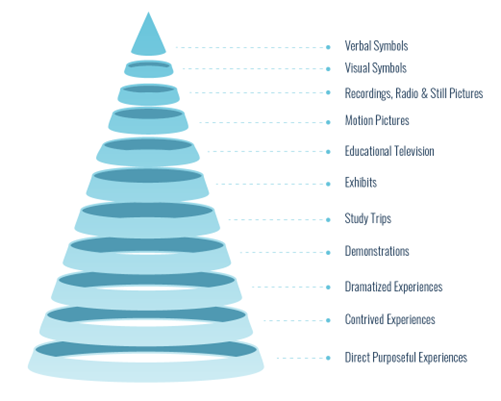
Ebbinghauss’ “forgetting curve” corresponds with Edgar Dale’s “Cone of Experience”.  In the 1960s Dale posited what he called the “Cone of Experience”.  Dale examined how people receive information.  He developed a model portraying the effectiveness of the mode for presenting new information and memory.  The isolated act of reading was the least effective while designing and making a presentation was the most effective. 

Later, misinterpreters of Dale’s work relabeled it the “Cone of Remembering” and this misinterpretation has been repeated until many believe it as factual.  This is the misinterpretation.

WE REMEMBER

10% of what we read.

20% of what we hear.

30% of what we see.

50% of what we see and hear.

70% of what we discuss with others.

80% of what we personally experience.

95% or what we teach others.

This is Dale’s Cone of Experience.

Presentation modes of verbal and visual symbols (words and graphics) are impersonal and less well remembered while the four experiential activities at the bottom of the cone require personal engagement and result in better retention.

https://uh.edu/~dsocs3/wisdom/wisdom/we_remember.pdf

Ebbinghauss and Dale inform us that memory is fickle and short-lived if it is isolated and left alone.

Capitalize on learning and make it memorable.

Further, Ebbinghauss’ research tells us that we can reduce the decline of memory by using several instructional strategies.  He found these to reduce forgetting.

  • Reinforce content, skills, and dispositions about learning regularly.  We know from retention theory that if we want information or skills to be accessible in short-term memory, students need 5-7 repetitions of mentally or physically working with they are to remember.  Theory tells us that 18 – 20 repetitions are required to create long-term retention.  If the biggest loss of memory is within one day, repetition must be at least daily to begin building memory.  This clearly is Ebbinghauss.

Consider automaticity of math facts.  We teach and drill children to learn addition, subtraction, multiplication and division math facts in the primary grades.  Then in the upper elementary and middle level grades we assume these facts are secured memory for all students.  In fact, they are not.  If we want to ensure automaticity, repeat episodes of the several times every year.  Make a game of it but do it.  Assumptions that children remember almost always leads to problems.

  • Presentation matters for clarity of what is to be remembered.  Make the new information easier to comprehend and absorb.  Assign smaller chunks of material to be read or watched.  Use visuals and graphics to assist students to make a clearer understanding of new information.  Build outlines, maps, and graphic organizers for students to link new information to what they already know.  This clearly is Dale.

https://www.lucidchart.com/blog/types-of-graphic-organizers-in-education

  • Make learning relevant and personal.  Motivation theory tells us that when students see themselves using new information or skills, they are more receptive to new learning and invested in remembering it.  Personalizing new learning gives students a purpose for learning and remembering it.
  • Make learning active not passive.  Use as many modalities for students to engage with new learning as are reasonable.  Approach new learning verbally – say it, write it, interpret it in a different language.  Approach it creatively – draw it, paint it, sculpt it, build it, sign it, and act it out.  Be careful not to let the projection of new learning become more important that the new learning itself.

https://asc.tamu.edu/study-learning-handouts/using-learning-modalities

What to do – Teach it, Teach it better, and Teach it again and again.

Teach less.  A grade level or subject area curriculum always contain more learning than can be accomplished within the confines of school year.  A teacher who says, “I taught everything in my curriculum or course guide” either has Cliffs Notes as a guide or is settling for very minimal student achievement in the end of year assessments.  This is not a license to discard a curriculum or course guide, but to carefully select the essential content information, skills, and dispositions that all students must learn and remember.  Both words are critical – learn and remember. 

Teach it better.  Use sound theories of instruction to build student retention and use of what they learn.  Chunk new learning for clarity.  Provide organizers of connecting new to secured learning.  Use multiple examples to help challenged learners find a connection to new learning.  The use of sound theories to teach essential new learning by itself will propel student achievement.

Make it meaningful.  Attach new learning to what students already know.  Attach new learning to the interests of the students, their families, and their community.  Attach new learning to what students will be learning and doing in their educational and career futures.  Once a child finds a purpose for learning, get out her way and simply coach her along the way.

Teach it again and again.  We parse our curriculum into units and chapters and almost never reteach or return to a unit or chapter once we complete it.  Then we wonder why students at the end of the year cannot recall with completeness or clarity what they learned at the beginning.  Take the time to repeat a chapter review from several chapters ago.  Check to know what students remember and can to with completeness and clarity.  If that knowledge or skill is essential, teach it again.  Do this rear-view mirror chapter review throughout the year.  You will see better student performances on end of year tests and future teachers of your students will be amazed at their longer-term memory.