
The Art of Breathing and Teaching

Breathing is an autonomic body function and is essential for human life. A healthy person breathes without thinking about it. When teaching children, knowing when to pause and take another breath to let learning unfold is a conscious act of breath control. Effective teachers know the art of breathing.

What do we know?

As a child, I was told to pinch my nose, jump into the deep end of the pool and swim. “Take a deep breath, hold it, and jump!” “Oh, and do not open your mouth to breath until you must. You will know when!”

As a student teacher, I learned to prepare an objectives-based lesson with a Madeline Hunter lesson design. When all students were seated and I had their attention, I took a deep breath and jumped into the lesson. Once I had connected the day’s lesson to yesterday’s lesson, I taught/swam hard moving through my lesson plan. My college supervised advised, “Once you have children’s attention, do not lose that connection until the lesson is finished. It is easier to keep them with you than it is to regain the attention of children you lost.” That mantra served me well until I looked up and around. Like a swimmer who has held his breath and come up for air, I was teacher in the middle of a lesson without knowing much about the children I was teaching. Their learning was secondary to my teaching.

Experience can teach us, and informed experience teaches us to create better experiences. I learned that I did not need to pinch my nostrils and hold my breath like a balloon under water. Diving headfirst was both more efficient and more exhilarating. I learned shallow racing dives and to hold a for four flutter kicks then to begin my stroke count and breath as planned. Informed practices created better experiences.

So, it is with teaching. Breathing may be autonomic, but effective teachers know how to pause, breathe, and let learning catch up with their teaching.

Intellectual breathing.

Hunter taught us to check for cognitive understanding. Checking is taking a breath from teaching finding the extent to which children are learning from your teaching.

Strategies for intellectual breathing include the following:

  • Cold calling. Do not ask for volunteers, but call in your “bell weather” students, the students who if they understand then most other students also will understand.
  • Think-pair-share. Students write quick responses to your question, share their response with another student, discuss and modify their mutual response, and report orally to the class.
  • Roll a question around. Ask a question requiring more than recall, one that causes a child to connect new learning with prior learning or provide a new context. Then ask another child to either agree, disagree, or add to the response. Continue with five or six students to push their thinking.
  • Quick quiz/ticket. Ask students to respond in writing to name the main points of the lesson so far, or to explain a concept in the first instruction, or formulate questions they have about what they have learned.
  • Use a visual fist to five. This strategy checks each child’s security with what they have learned. A five-finger wave says the child believes she has a high level of understanding, and a fist says, “I am confused.”

These are formative strategies that tell a teacher “Success. Keep teaching.” Or “Whoa, you need to reteach, correct, clarify, and reinforce what children know before going on,”

Emotional breathing.

Teaching usually is focused on what children think and know. Take a breath and pause to allow children to consider how they feel about what they have learned. “Aw, this is soft. Feelings do not help students on their statewide assessments.” Wrong!

Unlike the factual nature of checking for cognitive understanding, taking an emotional breath is observational and attitudinal. As children progress through a lesson or unit, their executive skills, social awareness, relationship skills, and ethical well-being are equal to their cognitive understanding.

Can or are all students able to –

  • Initiate and use a new skill independently? Can they self-start or are they dependent on their teacher?
  • Aware of the social context of what they have learned? Do they know that different economic, socio-political, cultural, or linguistic groups have a different take on the topic? Can they accept such diverse thinking? How do they feel about this?
  • Work with all other children in the class to extend their new learning. What groupings will help understanding? What needs to be done to improve child-to-child relationships?
  • See ethical and responsible decision-making issues in what they are learning? Can children self-regulate based on their ethical integrity?

Emotional breath taking relies on a teacher’s observational and perceptional acuity. First, a teacher must be self-aware of each of these. Second, a teacher needs to be aware of indicators of SEL indicators that children give off in their classroom experiences. Third, a teacher needs to be prepared to convert observation into planned instructions. If children are lacking in executive functions, teach them. If students are socially unaware, teach them. If children do not see ethical issues, teach them.

Taking a breath of emotional checking assures that teaching and learning are not mechanical but also humane.

Self-awareness.

Breathe also for yourself. Like the swimmer coming up for air, take a pause to help yourself adjust within the lesson. Stop teaching. Take a sip of water. Look around and breathe. Take time to see where you are in the classroom. As a mentor told me, “Pull your socks back up. You have been going at it strong.” I have seen teachers so “into their teaching” they are not aware that they have walked themselves into a corner of the room where the whiteboard hits the wall. One or two kept on teaching through the passing bell and when they turned around a new class of children was seated in their classroom wondering what they should do.

With experience, most teachers know when lessons are working successfully and when they are not. Perceptive teachers know when a lesson that is faltering lies in their preparation and when it is with them in the moment. They can take a breath and adjust themselves and their teaching.

At the same time, ineffective teachers do know how to breathe. They plow ahead in their ineffective lessons with ineffective practices.

The Big Duh!

Teaching is a human endeavor exercising the art and science of causing children to learn. Because we are human, we need to use our natural instincts to inform our uses of the arts and sciences. Effective teachers know how to stop teaching, take a breath, use the pause to monitor and adjust themselves and their instruction, and with new insights go forward.

Lastly, and most importantly, while you pause for breath look around at children engaged in learning. It is a most wonderful sight. And know that your pause for breath also is instruction and reinforcement to children that they also need to pause and breathe.

Master Teachers Know How to Correct Errors in Student Learning

“What, Romeo and Juliet die! They were young and in love. Did I miss something?”

Teaching and learning are not a linear transaction – a teacher speaks, and students do not always learn what the teacher wants them to learn. There are too many variables that intrude between the teacher and the children being taught. The eyes and ears and brains of children are not constantly connected to what the teacher is saying, doing, demonstrating, and explaining. In a child’s head, it does not take much, just an errant thought about a recent conversation with a friend, a side glance out the classroom window, a rethinking of a text the child read on the way to school, or an anticipation of after school doings, and whatever the teacher said, did, or showed was missed or received incorrectly. Or a child may get tired of reading and not finish the rest of the story. Or a child may rely upon what their small group mates tell them what they should know and not upon their own study. In these moments, correct learning lurches, and incorrect learning takes its place.

Best practice teaching also requires the pedagogic ability to clear up and clean up errors in student learning.

Identify errors in learning early.

A teacher must have ears that clang whenever she hears incorrectness. The clang occurs when a child says “2 + 2 = 5” or “Me and my friend …”, or “George Washington was President during the Civil War” or “Newton’s first law says objects are independent and move randomly.” CLANG!

Each clang requires correction. The issues for a teacher become when and how to make the necessary correction. “Do I stop everything, stop the lesson I am teaching, or the small group I am leading to correct a single student on a single point of misinformation?” Or “does every incorrect thing a child says need correction? If it does, I will never be able to teach anything new because there are so many little incorrect things children say or do.”

Yep, teachers need to plan how to correct errors, now or later. Identify and correct errors when they occur or as quickly as you can after you identify them. Student reality is that errors in their learning are reinforced and are used to distort subsequent learning the longer you wait to correct them.

No fault insurance – learning is what matters.

When correcting student learning, don’t place blame or fault on what caused the incorrect learning. Fault finding is a lonely and dangerous road. Use a “your fault, my fault, or anybody’s fault – I don’t care. We are going to correct this now” mindset. You want to correct learning and not focus children on faults.

If 100 children hear something that a teacher says, statistically only a fraction of them truly comprehend and internalize it accurately. The variables in attention, interpretation, and understanding mean that not all children are in sync with the instruction at hand. This discrepancy highlights the critical need for the teacher to hear the clangs of incorrect learning and make corrections. Given this, there is no time for fault finding; only correcting errors in learning and then moving forward.

The decision is either to make the correction now or at the end of the lesson or, if more than several students demonstrate the same error, to form a tier 2 small group for corrective teaching. Just do it.

Isolate the incorrect – replace with the correct.

Once the decision of when to correct errors in student learning is made, the steps for correction are similar.

  • Explain to students that you and they are going to correct errors in their knowledge content, or conceptualization, or skills they have learned because the error in learning will cause them to have learning problems in the future.
  • State the error in what they learned. “The idea that Romeo and Juliet do not die but live happily ever-after is an error. They die. Their deaths are what makes Romeo and Juliet and tragic love story.”
  • State the corrected learning. “Due to a tragic misunderstanding, Romeo kills himself with poison and Juliet uses Romeo’s knife to kill herself.” Romeo and Juliet die. No need to be graphic, just exact.
  • Give the students the context for their corrected learning by reviewing the family feud between the Montagues and the Capulets that prevented Romeo and Juliet from marrying, the friar’s plan to resolve the feud by faking Juliet’s death, and the scene when Romeo finds Juliet lying death-like but not dead. This review need not take long, just enough to give context to the conclusion – Romeo and Juliet die.
  • Have the students retell this conclusion and the summary of its context. It may seem like overdoing, but if there is a small group of students in this corrective, require each student to make a correct statement and summary of the context. Stating the corrected learning replaces the error with the correction.
  • Conclude by restating the importance of correcting and clarifying what students learn if we know it was not correct. And thank them for doing so.

The Big Duh!

I turn wood on a lathe to make a variety of products. Like any craftsman, my work is not always perfect. Flaws in my use of a bowl gouge combined with unanticipated changes in the wood cause mistakes. Craftsmen are not always error-free 100% of the time, but 100% of the time craftsmen know how to clean up their errors. Cleaning up takes time, effort, and technique. It is the correcting of errors that defines craftsmanship.

So, it is with teaching and learning. Teachers are craftsmen in causing children to learn. Teachers do not need to be effective 100% of the time in their instruction, but 100% of the time teachers need to correct errors in student learning.

We would rather a teacher use the time and effort to identify and correct errors in student learning and not teach everything in a year’s curriculum than teach every lesson in a year’s curriculum even though children have many errors in their learning. Errors in learning, like potholes in winter streets, only grow to cause major disruption later in the student’s life.

When There Is a Shortage of Teachers, Will Any “Teacher” In the Classroom Do?

Every year school principals post openings for classroom teacher vacancies with the intention to hire a licensed teacher with the academic and pedagogic preparation to teach the children a school curriculum. However, the shortage of licensed and prepared teachers seeking employment as teachers means that a principal may not find any candidates with a valid license to teach the posted assignment. This is New Personnel 101 for principals in thousands of schools every year – how to make do without a licensed and prepared teacher.

So, a principal scrambles to hire the next best – a teacher with a different license but who knows how to teach. Or a long-term substitute teacher without a teaching license or academic and pedagogic training. Or an apprentice teacher who is enrolled in an on-the-job teacher preparation program but not yet fully trained. Or a local resident well known in the school who has a baccalaureate degree and is willing to try out as a classroom teacher. The WI Department of Instruction has protocols for issuing permits or temporary licenses with stipulations that allow a school board to employ any of these people who are explicitly prepared for the vacant teaching assignment. Or the principal may give up on finding a teacher and reassign the children to other classrooms. Each of these options has an immediate upside and a longer downside.

New Personnel 101 does not go away when an unlicensed, unprepared teacher is hired. The principal is supposed to continue posting this position as a teacher vacancy until a licensed and prepared teacher is hired. If an unlicensed teacher with a temporary license is hired, the principal is responsible for assuring and supporting the “temp” in meeting the stipulations of the temporary license. That amounts to significant extra time and effort. New Personnel 101 is an ongoing unanticipated and unwanted work effort.

The rub comes if the principal believes the “next best” is good enough and that reposting will not find a better “next best.” This is acutely true if there are no student discipline or parent issues arising from a “next best” teacher in a temporary assignment. The WI DPI will renew a temporary license with stipulations almost indefinitely, if the temporary teacher continues to make “efforts” to remove the stipulations of the temporary license. It does not take much to be an “effort.”

The sad outcome of New Personnel 101 is that a continuing contract for “next best” who never completes a licensing program but never has classroom problems gets lost in all the other high demands a principal faces in the business of administering a school. When the critical attribute for good enough is the absence of discipline problems and parent complaints, the good enough of New Personnel 101 makes the expediency of putting a teacher in the classroom more important than giving all children the quality instruction they deserve and need.

The reality of New Personnel 101

There is a significant corps of unlicensed teachers in our classrooms. “Different sources estimate between 42,000 and over 100,000 unfilled teacher positions nationwide. Moreover, another 270,000 to 365,000 employed K-12 teachers are reported to be unqualified or not fully certified for the teaching assignments that they have been given. In some areas, the inability to find qualified teachers is so bad that anyone who passes a background check gets hired, even without holding a relevant degree.”

In Wisconsin, there are 2,400 unfilled teacher vacancies for the 2024-25 school year with 4,057 unqualified teachers in classrooms.

https://www.fullmindlearning.com/blog/teacher-vacancies-by-state-us?utm_source=chatgpt.com

Apprenticeship resolves New Personnel 101.

One of the options available to school boards is to employ apprentice teachers. An apprentice teacher meets four immediate criteria. An apprentice must –

  1. Have an earned baccalaureate degree. Although this baccalaureate is not in education, it signifies that the apprentice has intellectual knowledge and skills for a college degree and the capacity to become a trained teacher.
  2. Be enrolled in an educator preparation program (EPP). There are a variety of EPPs in Wisconsin and most are affiliated with Cooperative Educational Service Agencies (CESAs). The DPI teacher licensing department supervised EPPs to ensure that the EPP’s teacher training program meets WI’s statutory requirements for teacher training as well as the initial teacher preparation standards for a teaching license. For example, all licensed math teachers must meet the preparation standards of the National Council of Teachers of Mathematics (NCTM).
  3. Be employed by a school board as an apprentice teacher assigned to a classroom aligned with their educator preparation program. Employment as an apprentice is a HUGE asset for apprenticeship programs – apprentices earn while they learn. Unlike enrollment in a college or university teacher prep program that require almost full-time class attendance, apprentices teach classes in school, attend the EPP’s online courses, and have an ongoing income that meets their life needs.
  4. Pass a criminal background check. This is the same requirement for all public education teachers.

The essential benefit of the apprenticeship program is that a “next best” teacher is not hired and forgotten. Apprentices are supported by

  • EPP instructors. I use preparation for a math teacher as an example. As apprentices learn each of the seven NCTM teacher prep standards, the instructor uses course assignments that directly connect each standard to the apprentice’s teaching assignment. Apprentices use their daily work as the application of each standard. Instructors are first-hand supporters of the apprentice’s daily teaching practices.
  • EPP licensing observers who observe the apprentice teaching and coach the apprentice to apply what the apprentice learns in EPP courses into practice in classroom teaching.
  • School principals who make required evaluative classroom observations of the apprentice’s teaching and provide the apprentice with both critical and constructive recommendations.
  • School mentors who teach the same grade level or the same courses as the apprentice.

The downside to hiring an apprentice teacher is that on the first day of classroom teaching the apprentice also is in the first days of course work learning how to teach. As a teacher, the apprentice immediately is a work in progress.

The upside to hiring an apprentice is that the apprentice is constantly learning about the best teaching and learning practices. There is not a settling for good enough that never changes because the apprentice is constantly learning how to become a fully prepared licensed teacher. And at the end of the apprentice’s EPP courses the apprentice has pedagogical training that is equal to the preparation of any university or college depart of education.

The Big Duh!

New Personnel 101 leaves school boards and principals with critical decisions to make when they cannot find a fully licensed teacher that meets their employment needs. They can settle for a “good enough” adult to be a classroom teacher.  They can allow “good enough” to become a permanent employee forgotten in the grind of a school year’s work. Or they can work with an EPP and hire an apprentice and collaborate to create a fully prepared and licensed teacher.

I endorse the employment of apprentice teachers. Through personal and professional experience, I know that this program works when school principals and EPPs collaborate to educate, train, and grow a new teacher one at a time.

New Personnel 101 is not going away. The lack of new teacher candidates is a recurring fact of school life. The question of how to make do with less than fully prepared teachers is our problem and requires school boards and principals to invest in new strategies for causing all children learn.

Reflection On Instruction Begets Improved Student Learning – Give Teachers Time to Reflect

Time and tide wait for no teacher when there is a school year of curriculum to be taught. There never is enough time to accomplish what takes inestimable time! Instruction that causes all children to learn, including children needing adjusted instruction, requires time for a teacher to reflect and determine how to clarify, correct, and teach anew. Reflection plus adjusted teaching improves learning for all students.

Form follows function – time is attached to what we prioritize

A teacher’s school day is dominated by the clock much like the chain driving an assembly line. Classes, meetings, lunch, prep, paperwork, work that goes on til midnight and then do it again the next day. The class bell does not wait for anyone – teacher or student – and a tardy teacher is worse than a tardy student. And being prepared for the continuing instruction and student learning is never-ending. Yet we know that significant accomplishments – Rome and student learning – require planning, careful work, and checking assurances for quality outcomes. When then, is a teacher able to reflect, really think about the effectiveness of her teaching in causing children to learn?

The easy answer for administrators has two parts.

  • Every teacher has contract-guaranteed prep time as well as time before and after the school day.
  • Professional teachers understand that their work is not limited by the school day and often requires more than eight hours per day.

Easy for an administrator is not easy for a teacher. A teacher’s school-assigned prep time is invaded without forethought. Urgent matters are a principal’s note to “see me during your prep” or a principal’s scheduling an IEP team meeting during a prep time. The “tapping into” teacher prep time happens with abandon in every school every day.

A teacher’s immediate needs must be met during “untapped” prep time. These include

  • Bio needs in the restroom.
  • Returning parent calls and e-mails.
  • Assembling student work collected prior to the prep time for later inspection.
  • Arranging materials for student instruction after the prep time.

If these are not accommodated during school day prep time, they don’t get done. Consequently, these tasks get done and instructional planning and reflection do not.

Before and after school time also is requisitioned by faculty meetings, grade level and departmental meetings, IEP team meetings, and professional development. Then, add the time needed by a student who “needs extra help” or has a question that could not be asked and answered in class and an eight-hour school day grows into nine and ten hours. The time crunch is exasperated for the many teachers who need to be home after school to take care of their own children.

The reality is that very few teachers use school day prep time for the planning and construction of instruction or the review of instructional effectiveness.

Automaton teaching is easy; informed teaching is hard

It is too easy for a teacher to be an automaton – a person who works in a mechanical, unthinking, and unemotional manner. I observed veteran teachers who had files of units and lesson plans and every year they literally taught through their file drawer. They used the same units and lessons year after year with the justification of “it seemed to work last year, so it will be just as good for this year.” When asked why they automatically repeated units and lessons, they told me “It took a lot of time to develop my units and lessons, and I don’t have time to develop ones or even to change why I have.”

Automaton teaching includes teachers who teach strictly from the publisher’s guide for curriculum their school has adopted. They do not make adjustments or modifications because “this is what my school board expects me to teach.”

Against this model, I observed veteran teachers who used their prep time for informed teaching. From her classroom doorway, I watched a kindergarten teacher using self-talk as she laid out materials on student desks. “Willie needs…, Jackie needs…, Aiden needs…”, and at the end of the lay out she reviewed exactly what each student needed to accomplish the objectives of their next lesson.

I watched a high school chemistry teacher use her whiteboard to review the results of a student quiz the day before. She used data to identify students who demonstrated clear learning and those who did not, and she listed the specific learning that needed to be clarified.

I talked with an ELA teacher as she shared the specific criteria, she had taught that she wanted students to demonstrate in a writing assignment. She used a holistic reading approach to identify assignments that met the requirements and those that did not and added post-a-notes to each writing sample telling the writer the detail that was missing or incorrect.

These teachers buck the pattern of automaton, same old/same old teaching by reflecting daily on the effectiveness of instruction and the adjusted teaching they will use to cause all students to achieve curricular success.

Break the pattern of same old/same old: protect time for instructional reflection

If a principal believes reflection is essential for ensuring high quality teaching and learning, the principal must assign and protect time for reflective work. The time does not need to be the same time of the school day for all teachers. If it is the same, it is too easy for that time to be stolen for other purposes. Ensured reflective planning time needs to be equitable, balanced and inviolate.

Second, the principal needs to “sit in” with teachers as they reflect. “Sitting in” is supportive not evaluative. Different teachers will reflect and plan differently; the just need the principal’s encouragement and affirmation that instructional reflection is a valued professional for improving teaching and learning.

Plan-teach-reflect-teach

I always smiled when told “Mr. Smith is a good teacher” without hearing the criteria for the statement. It was a cynical smile. Good teaching is hard work that requires curricular and pedagogical mastery and consistent use of best practices. Good teaching knows each child being taught and how to connect each child’s uniqueness with instruction. Good teaching requires planning, teaching, reflection, and adjusted teaching. When I heard any or all of these criteria, I gave a true smile.

To make the magic of teaching work, teachers need time to assess the quality of student learning after their initial instruction, provide appropriate next assignments for students who were successful, AND plan how to correct, clarify, and appropriately students who were not initially successful. The magic requires informed reflection and time to reflect.

Teach For Enduring and Expansive Learning Not Coverage. Know the Difference.

“Your teacher covered that last year” or “this semester we will cover” still rankles my professionalism as a teacher. Teaching for coverage means nominal teaching and learning. It means spending the least amount of time engaged in teaching and learning for the sake of topical accountability. Coverage teaching is like the proverbial river that is a mile wide and an inch deep – it emphasizes breadth without depth. In my naivety as a young educator I believed that if something was worth teaching it was worth learning well and that meant deeper teaching and learning. Conversely, why waste time and energy on teaching things we did not plan for children to learn well? I still believe this.

Years ago when I heard my principal or district curriculum leader talk of coverage, I assumed they were generalizing about the amount of information in any grade level of our social studies curriculum and the finite amount of instructional time in an academic year. But they weren’t. “You can’t teach everything in your curriculum with the same level of intensity” I was told. “So, cover it all.” It took me a long and troublesome time to understand this, however understanding did not mean accepting it.

There is a line between coverage and knowing and understanding.

Early on in teacher training, we are taught Benjamin Bloom’s Taxonomy. In the 1950s Bloom established six levels of thinking, learning, and understanding with labeling that helps us explain a rationale for teaching and learning designs. Seventy years later, I still like how Bloom helps me to add depth to the “wide river” of information we teach. The model below shows a revised taxonomy – the terms have been modified from Bloom’s original for clearer explanation of the cognitive levels.
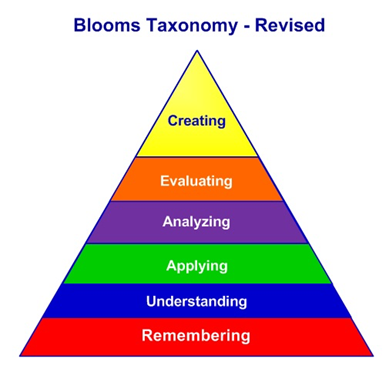
bloom’s taxonomy revised – Higher order of thinking

Although there is a vertical dimension to the taxonomy, Bloom did not intend for all teaching to involve all six levels. Curriculum planners use the levels as goals for teaching and learning. Some learning, in fact most of what we learn, is meant to be at the remembering/understanding level of usage. Other learning is meant to be scaffolded into a variety of applications, or to inform careful analyses, or to evaluate options and opportunities, and to create original work. Though it looks like a ladder, a user does not use every rung to engage in higher order cognition. Instruction and learning can scaffold from understanding to analyzing, or evaluating, or creatin.

Coverage teaching is the act of “mentioning” without the explicit intention of remembering. There is a lot of mentioning in education. Synonyms for mentioning cause us to smile and acknowledge that teachers mention without teaching. When a teacher “alludes to, refers to, touches upon, hints at, speaks about briefly, broaches or introduces only,” that is mentioning. Children may or may not hear or read what a teacher mentions as an aside. Things that are mentioned are characterized as “things it is nice to know but it is okay not to know.” Like, the value of pi is abbreviated to 3.14. As an irrational number, Pi can be calculated out to an infinite number of numbers but who cares? A math teacher covers or mentions that fact but directly instructs that the usable value of pi is 3.14. Best practice does not include “mentions” in assessments of student learning, although there is a lot of bad practice in the field.

Coverage may be all the questions on Jeopardy that sound somewhat familiar but just will not come to mind.

I think of coverage as the blank space below the bottom of Bloom’s taxonomy; it is the noise in the world we are not intended to remember.

Remembering and understanding is the meat and potatoes of most teaching. The information – facts, data, concepts, generalizations, and skill sets we want children to know, we teach with high intention. In the language of backward design, if we intend to test children on something, we intend to teach it well so that it will be remembered and understood.

Direct instruction is one of many teaching strategies most often used when we teach for remembering and understanding.

Children learn the alphabet and numbers, sight words and number facts early as foundational knowledge. In school we use direct instruction to drill and practice and ensure memory of these. Retention theory drives our teaching for remembering – we use immediate drill and practice/repetition to strengthen short-term memory and interval practice over time to ensure what is learned is retained and recalled in long-term memory. In a spiraled social studies curriculum, we teach US History in elementary, middle school, and high school because we want all children to know their national stories. Repetition and elaboration cause remembered learning.

Remembering is a student’s identical retelling of information or identical demonstration of what was taught. We require correct and complete retelling.

Understanding is explaining what was taught with fidelity in the student’s own words and doing the skill with fidelity in the student’s own style. Understanding is using what is remembered and making an inference about it or summarizing it in simpler language or combining several pieces of information into meaningful statement that keeps the significance and essence of what is being combined.

There also is a line between knowing and understanding what we learn and the rest of Bloom – what comes next is the so what of education.

Separating the noise of information from the teaching of remembering and understanding, gets us to the “so what” levels of Bloom where what was learned is applied, analyzed, evaluated, and built upon creatively. These four Bloom levels give us the rationale for why teaching for remembering and understanding are such a large part of our school calendar. Without foundational memory about stars, planets, moons, suns, constellations, galaxies, and a universe(s), nothing we see in the sky above us would make sense. Space would just be space. Lifesaving surgery would be butchery. Agriculture and manufacturing would just be guessing work.

Other teaching strategies become available when students have a knowledge and understanding of foundational information and skills. I use the C3 Framework for social studies as an example of instructing above the remembering and understanding line. C3 (College, Career, Civic Life) uses an inquiry process for students to investigate, expand and integrate their knowledge of civics, economics, geography, history, and the behavioral sciences.

“The C3 Framework, like the Common Core Standards, emphasizes the acquisition and application of knowledge to prepare students for college, career, and civic life. It intentionally envisions social studies instruction as an inquiry arc of interlocking and mutually reinforcing elements that speak to the intersection of ideas and learners.” C3 uses “questions to spark curiosity, guide instruction, deepen investigations, acquire rigorous content, and apply knowledge and ideas in real world settings…”

https://www.socialstudies.org/standards/c3

This is not coverage teaching!

Parallel to C3, curricula in every school subject, from art to woodworking, builds upon information and skills students learn at the remembering and understanding levels of instruction. The front of a refrigerator in most student homes is covered with student drawings and finger paintings. Over time, shelves and walls display how student application of basic information and skills blossoms into more intricate and sophisticated art. Student art displayed in local galleries, libraries, and art shows illustrates how student artists apply of fundamental concepts and skills, analyze and interpret subjects, and create new and original art.

Tech ed students manufacture, ag students grow and cultivate, computer science students program and engage in robotics, ELA writers craft poems and stories, and marketing ed students create businesses, apply accounting, create and manage product, lead and supervise personnel in the pursuit of economic growth. Once students know and understand, they can pursue their personal interests for a lifetime.

Know and be the difference.

There is so much in a teacher’s annual curriculum and so little time that it is easy to fall into the coverage mode of teaching. But why? In today’s world, coverage learning is what any child can achieve using Google or AI.

Two centuries ago, teachers were the source of information and applied learning. A century ago, students could read books for information; it was teacher directed and interpreted learning that moved children to young adults ready for college or work. Today, information sources abound, so much so that it hard to know information from noise. Today it takes a teacher to forge information into memory and understanding. And it takes a teacher to guide, monitor, and mentor how students illustrate and expand their learning. Well-conceived and instructed learning remains a springboard for life’s successes.

There is no time or place today for coverage teaching.